Apnea of prematurity
Apnea of prematurity is quiet. That is the problem.
NeoBreath is a wearable monitoring and intervention system being developed for premature infants: a respiratory sensing belt that processes signals on board, a foot-worn SpO2 and heart-rate module, and a mobile app for the people at the bedside.
In development — not yet clinically validated.
The problem
A pause the room cannot see
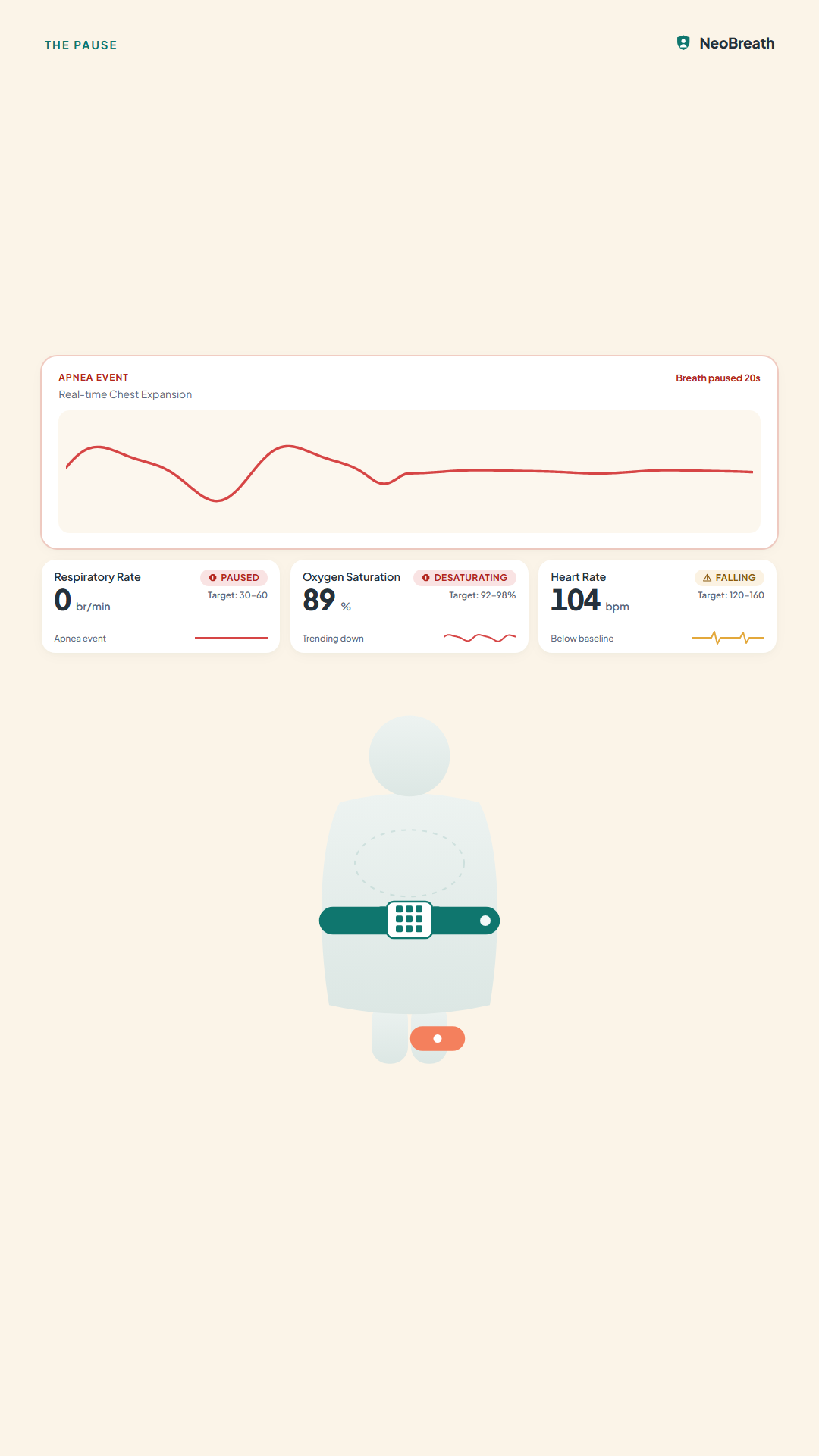
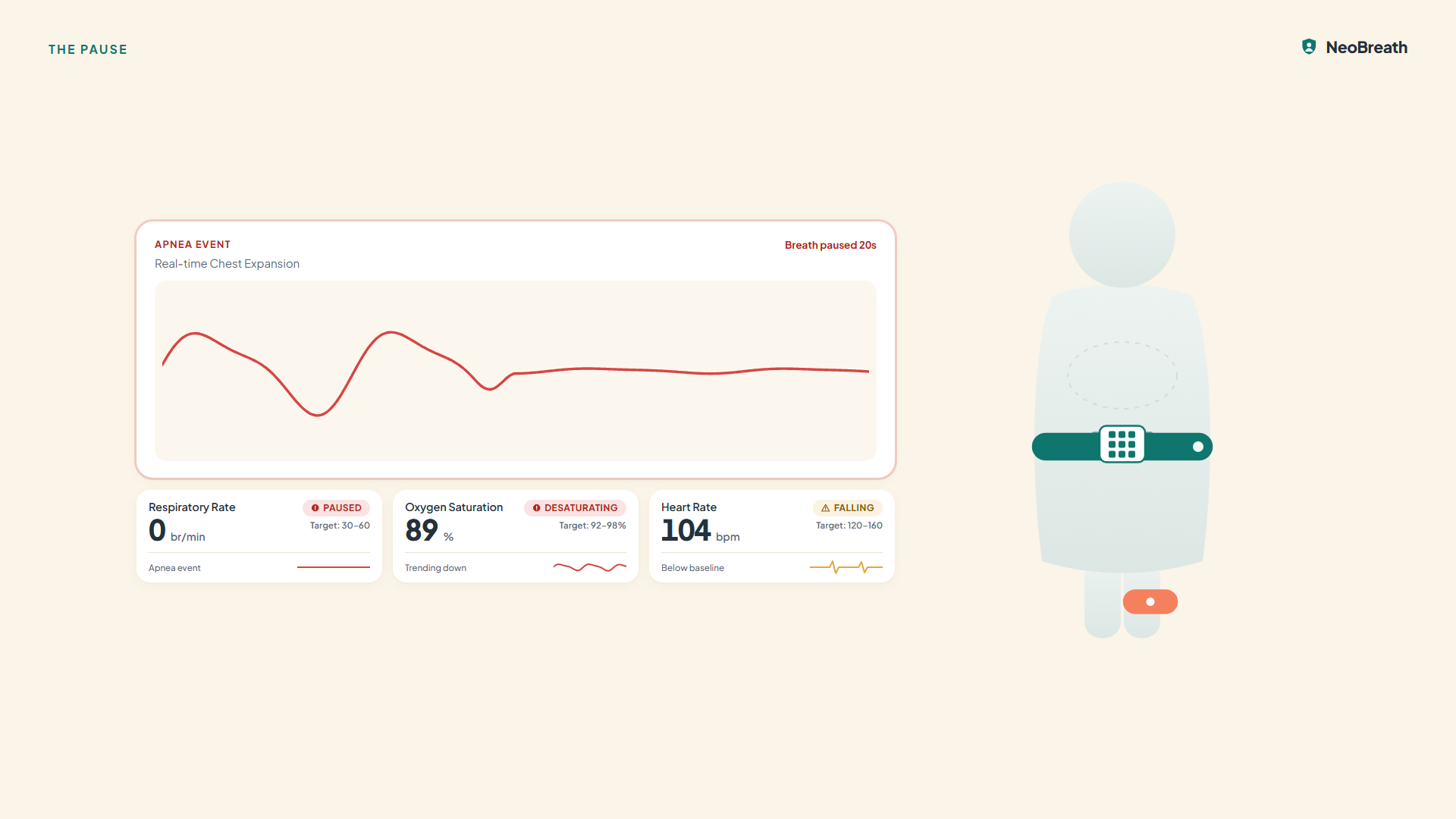
Apnea of prematurity is a pause in breathing that is common in infants born early, and it often arrives alongside bradycardia and falling oxygen saturation. The infant cannot ask for help. In a busy nursery, the gap between two breaths is not something a person can watch for continuously.
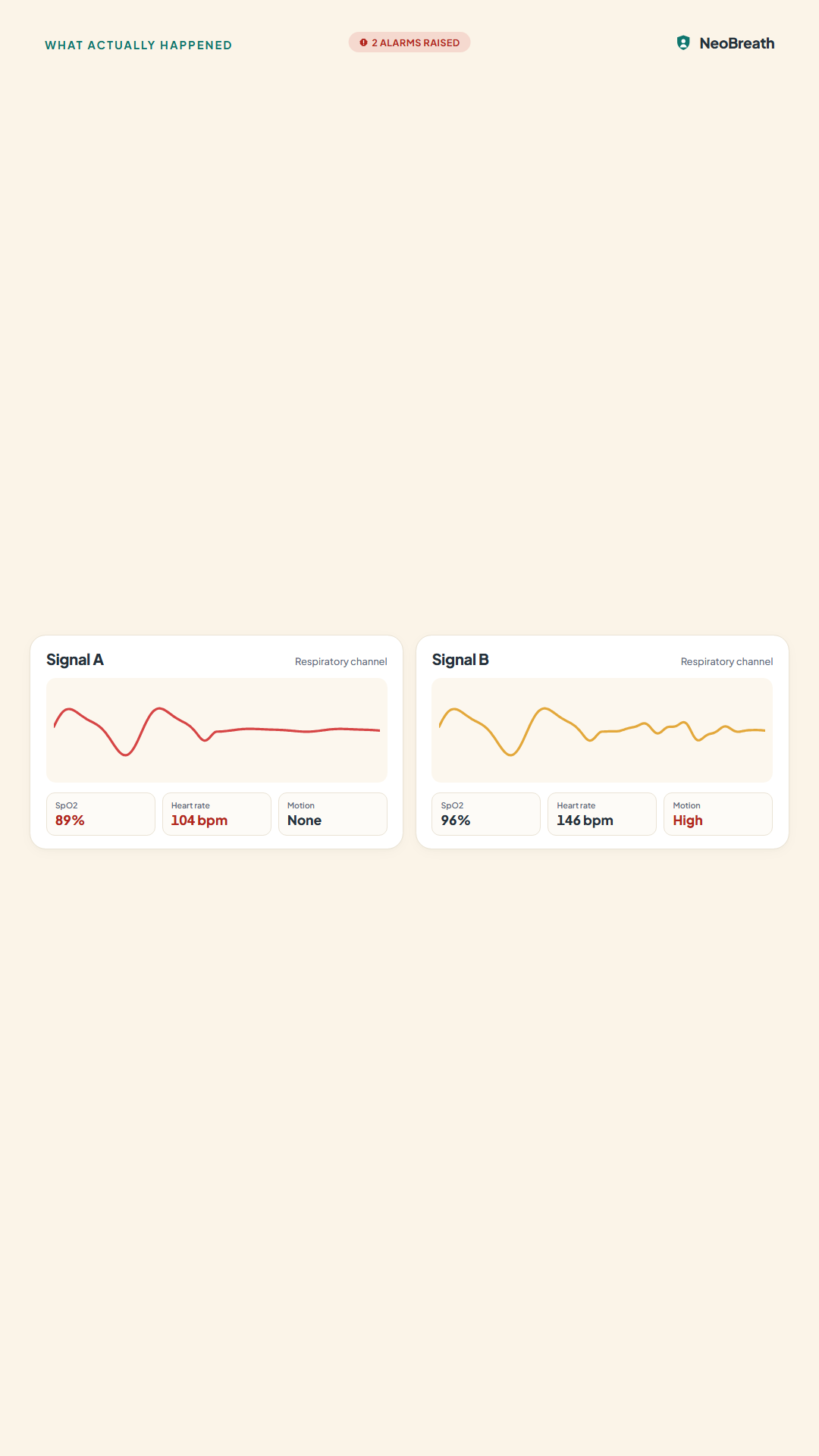
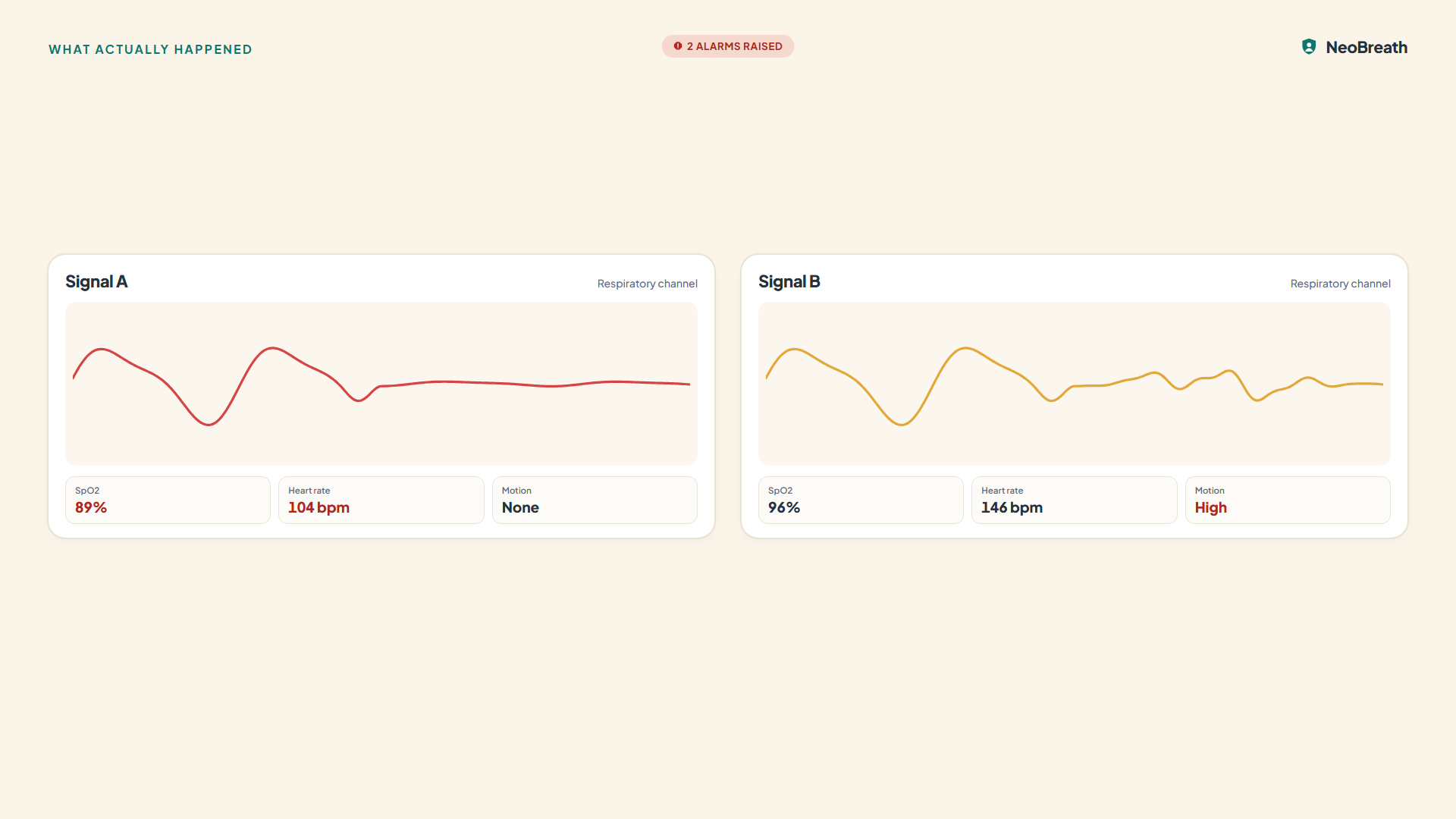
The trace collapses. No movement to give it away.
The trace also collapses — and carries motion noise.
A fixed threshold cannot tell these apart. Reasoning over the trace shape and the other channels can. That distinction is the whole of the AI work below.
Apnea of prematurity affects preterm infants, whose control of breathing is still developing.
Manual observation depends on a person watching. Human attention is not continuous, and it is not meant to be.
Published work from the same research line reports a high proportion of false central-apnea alarms in clinical practice.
Apnea monitoring is often unavailable or unaffordable in low- and middle-income settings, and manual monitoring is prone to human error.
What NeoBreath is not
- Not a SIDS prevention device. We make no claim about sudden infant death.
- Not a consumer baby monitor.
- Not a multi-infant nurse triage platform. That was deliberately excluded from the current scope.
- Not clinically validated yet, and not a replacement for professional care.
The system
One belt. One foot module. One app. One infant.
The belt senses respiration and interprets the signal on board. A module worn on the foot tracks oxygen saturation and heart rate. The app is the caregiver's window into both. There is no separate processing hub, and no dependence on a cloud round-trip.
- 1SenseRespiration, SpO2, heart rate
- 2InterpretOn the belt's microcontroller
- 3InterveneVibrotactile stimulation
- 4NotifyTo the caregiver's app
Respiratory sensing belt
TODAY— Built and demonstrated in the current prototype. Fitting sensing, wireless communication and potential ML inference inside the belt's processing and power budget is an open engineering challenge, not a solved problem.Sensing of chest and abdominal movement, with signal processing running on the belt's own microcontroller rather than in a separate box.
Foot-worn module
TODAY— Built and demonstrated in the current prototype.A second physiological channel — oxygen saturation and heart rate — so that interpretation has more than one signal to reason over.
On-board processing
IN DEVELOPMENT— Active engineering or research work. Not finished. Constrained by the belt's processing and power budget.Interpreting on the wearable means lower latency, less dependence on connectivity, and raw physiology that does not have to leave the device.
Vibrotactile intervention
TODAY— Built and demonstrated in the current prototype.When an event is detected, the belt applies gentle mechanosensory stimulation to the infant.
Mobile app
TODAY— Built and demonstrated in the current prototype.A live breathing waveform, current vitals, event alerts and history — written for a caregiver who is tired and standing up.
One device, one infant
TODAY— Built and demonstrated in the current prototype.The current scope is deliberately a single infant per device. Prioritizing many infants for one nurse is not part of this work.
Breathing normally
Continuous monitoring active · All vital signs within safe target range
Real-time Chest Expansion
Continuous Vitals
Respiratory Rate
44br/min
Oxygen Saturation (SpO₂)
96%
Heart Rate (Pulse)
148bpm
The caregiver’s view. Every resting status is teal; the amber and red states are reserved for real changes.
The AI
Telling a real pause apart from a kicking leg
A wearable does not produce a clean physiological signal. An infant moving can generate a pattern that resembles deterioration. A fixed threshold cannot tell the difference — and that is what drives false alarms.
What we are working on now
Artifact rejection
IN DEVELOPMENT— Active engineering or research work. Not finished.Decide whether a fall in the respiratory signal reflects a genuine event or a sensor artifact.
Signal classification
IN DEVELOPMENT— Active engineering or research work. Not finished.Reason over respiratory morphology, oxygen saturation and heart rate together, rather than one channel alone.
Fewer false alarms
IN DEVELOPMENT— Active engineering or research work. Not finished.The purpose is a more trustworthy alarm, not a demonstration of machine learning.
Inference at the edge
IN DEVELOPMENT— Active engineering or research work. Not finished. Constrained by the belt's processing and power budget.Run the model on the wearable, inside its processing and power budget.
Candidate model families
Decision trees, regularized logistic regression, small gradient-boosted models, and lightweight neural networks.
No specific model has been established as the final NeoBreath model. This is an open question, not a settled design.
On the stimulation
We are exploring gentle vibrotactile mechanosensory stimulation, informed by research into mechanical stimulation and stochastic resonance in apnea of prematurity.
IN DEVELOPMENT— Active engineering or research work. Not finished. Informed by research into mechanical stimulation and stochastic resonance. The therapeutic benefit of mechanical stimulation does not establish that randomness is the active mechanism.The therapeutic benefit of mechanical stimulation does not establish that randomness is itself the active mechanism. We treat that as an open scientific question.
Where this direction comes from
This direction is informed by published research on machine-learning-based central apnea detection in premature infants, including work by Varisco et al.
IN DEVELOPMENT— Active engineering or research work. Not finished. The literature supports the research direction. NeoBreath has not yet demonstrated equivalent clinical performance, and must never imply that it has.We cite that literature as evidence that the approach is worth pursuing. It is not evidence about NeoBreath.
Roadmap
Three levels of response
Today NeoBreath reacts. The research direction is preventive, and then adaptive — each level depending on the one before it.
- Level 1TODAY
Reactive
Event detected → tactile stimulation
The system detects an apnea event and responds. This is closest to what the current prototype does.
TODAY— Built and demonstrated in the current prototype.Each level depends on the one before it. - Level 2RESEARCH
Preventive
Rising risk → preventive stimulation
The system identifies increasing risk before a full event and intervenes earlier. This depends on predictive AI that does not exist yet.
RESEARCH— Future direction. Not yet validated, not yet built, not yet available. Requires substantially more longitudinal data than the initial artefact-rejection problem.Each level depends on the one before it. - Level 3RESEARCH
Adaptive
Individual baseline + predicted risk → individualized response
The system learns one infant's respiratory behavior and adjusts its response to that infant.
RESEARCH— Future direction. Not yet validated, not yet built, not yet available.
The loop we are working toward
- 1SenseRespiratory signal, SpO2, heart rate
- 2InterpretSeparate event from artifact
- 3PredictEstimate rising risk — research
- 4InterveneStimulation, preventive or reactive
- 5ObserveDid the infant respond?
- 6AdaptUpdate the individual baseline — research
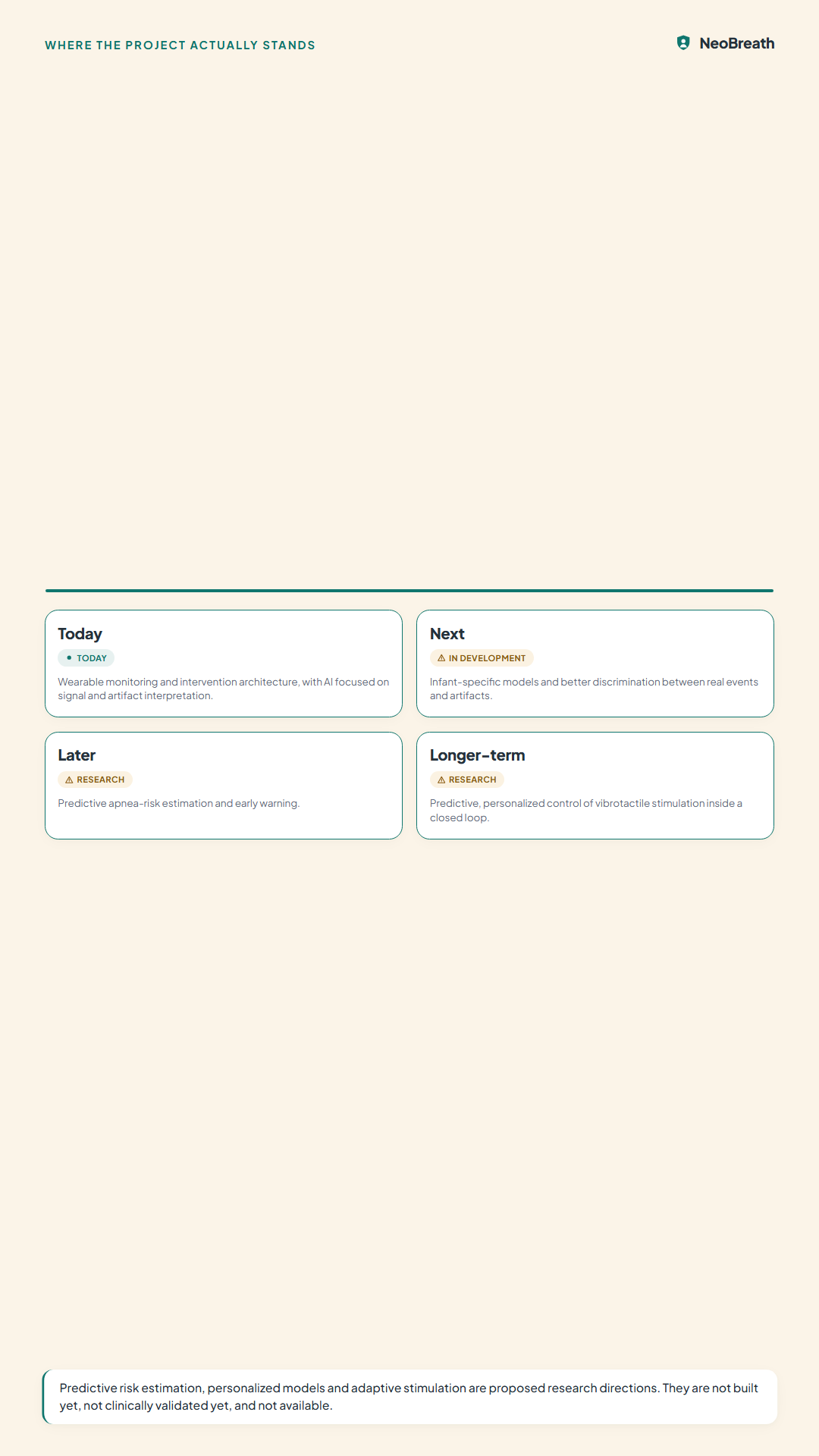
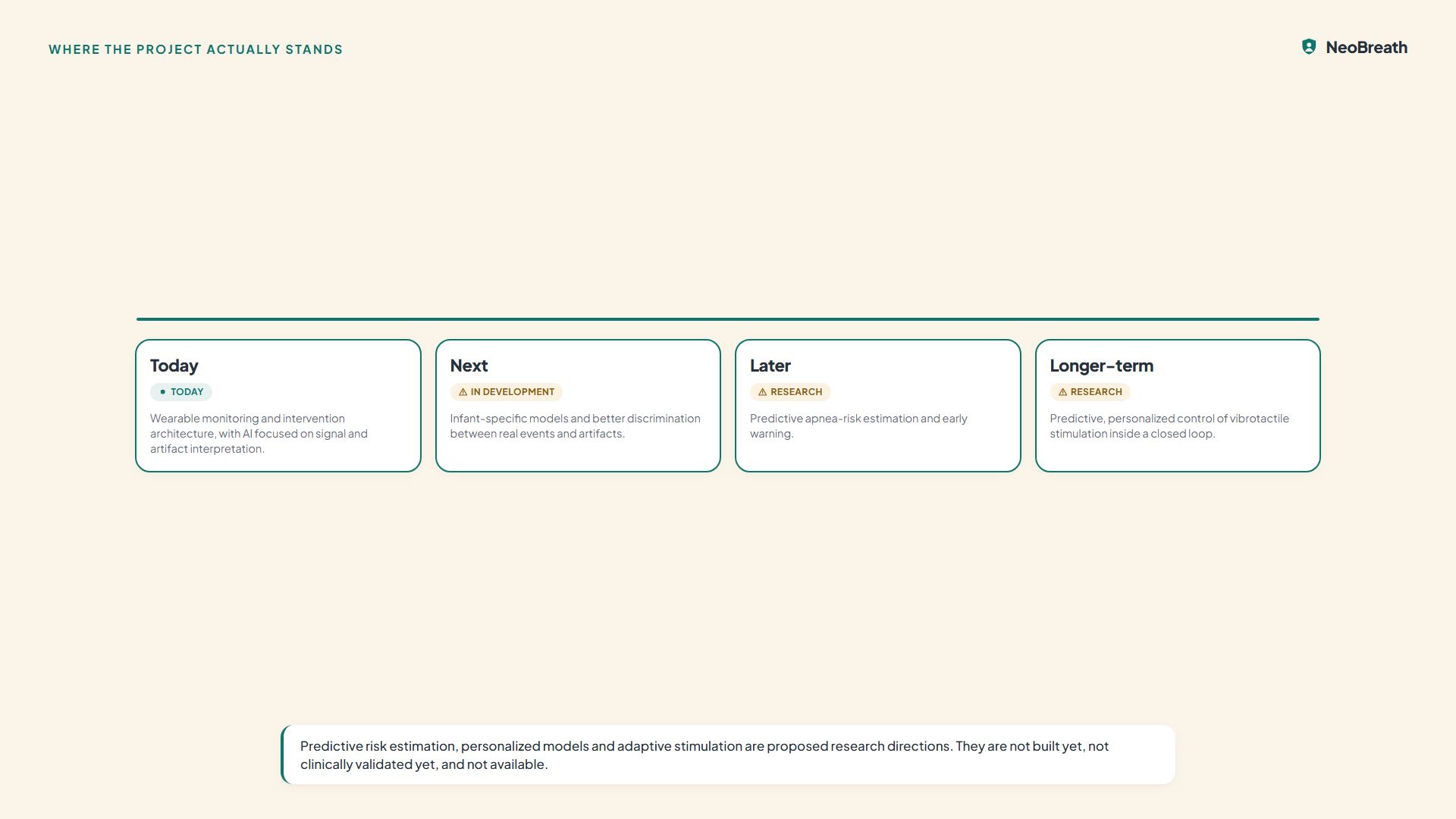
Where the project stands
Today
TODAYWearable monitoring and intervention architecture, with AI development focused on signal and artifact interpretation.
Next
IN DEVELOPMENTInfant-specific models and improved discrimination between events and artifacts.
Later
RESEARCHPredictive apnea-risk estimation and early warning.
Longer-term research
RESEARCHPredictive, personalized control of vibrotactile stimulation inside a closed loop.
Evidence
What we have actually built
A working prototype, shown in public. The findings below include the parts that did not work, because those are the ones we are working on.
Wireless transmission of sensor data to the mobile app works.
TODAY— Built and demonstrated in the current prototype.The breathing waveform is visualised in the app in real time.
TODAY— Built and demonstrated in the current prototype.The alarm fires and reaches the caregiver when an apneic event is detected.
TODAY— Built and demonstrated in the current prototype.The belt picks up abdominal movement, but sensitivity is not yet where it needs to be.
IN DEVELOPMENT— Active engineering or research work. Not finished. Stated deliberately as an open engineering problem. Do not soften it into a success.
Shown at the Pediatric Society of Ghana
The prototype was presented at the Pediatric Society of Ghana conference on prematurity.
See the showcaseSupport the work
NeoBreath is being developed at KNUST with the DIPPER Lab. If you work in neonatal care, medical devices, or signal processing, we would like to hear from you.