Technology
How the system is put together
Sensing, signal processing, event detection, intervention and notification — and where each part currently stands.
- 1
Sensing
The belt senses chest and abdominal movement. A foot-worn module adds oxygen saturation and heart rate as a second, independent channel.
TODAY— Built and demonstrated in the current prototype. - 2
On-board processing
The signal is filtered and interpreted on the belt's own microcontroller. There is no separate hub, and no cloud round-trip in the detection path.
TODAY— Built and demonstrated in the current prototype. Fitting sensing, wireless communication and potential ML inference inside the belt's processing and power budget is an open engineering challenge, not a solved problem. - 3
Event detection
The system decides whether a change in the respiratory signal represents a genuine event or a sensor artifact.
IN DEVELOPMENT— Active engineering or research work. Not finished. - 4
Intervention
When an event is detected, the belt applies gentle vibrotactile mechanosensory stimulation.
TODAY— Built and demonstrated in the current prototype. - 5
Notification
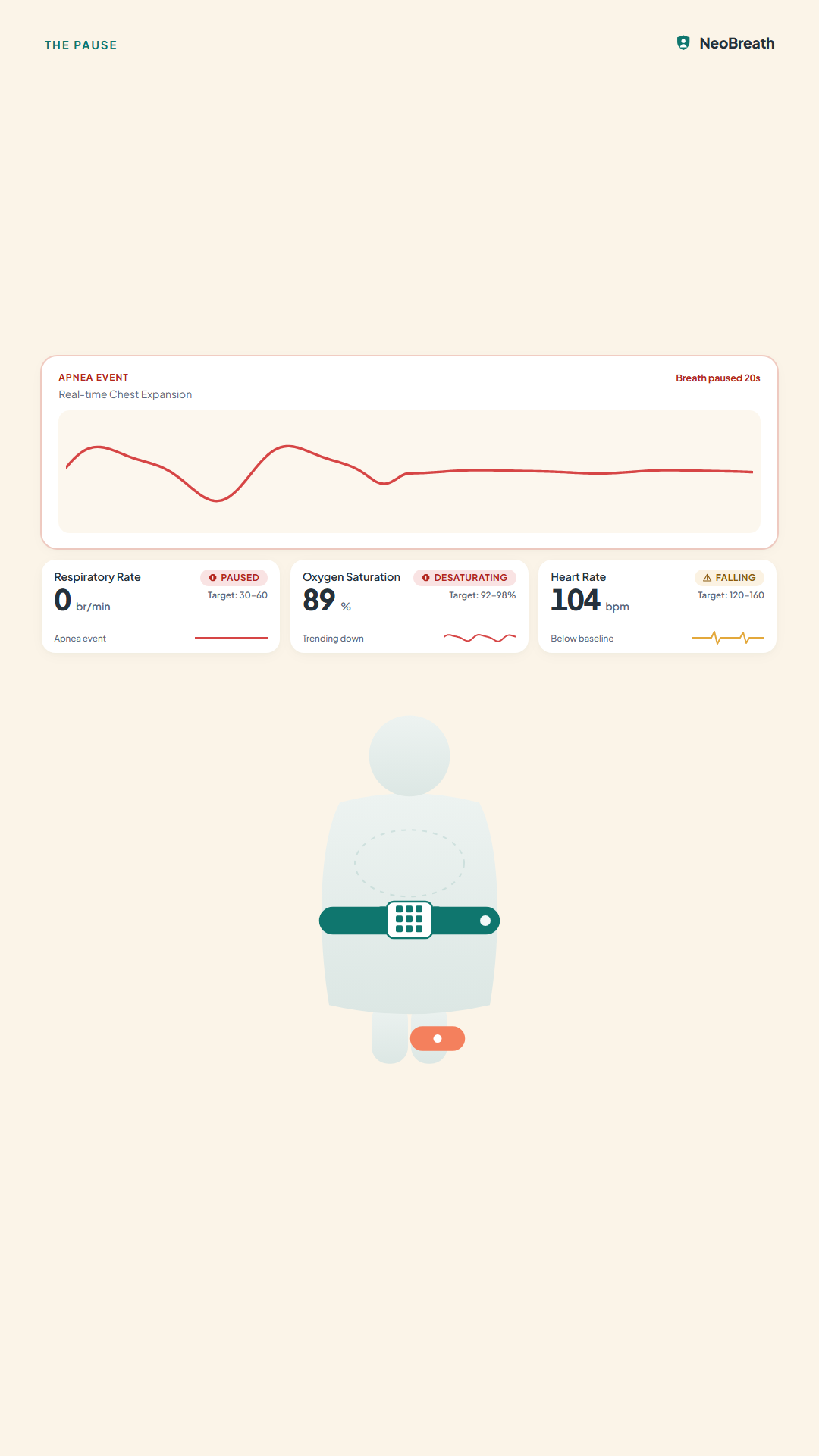
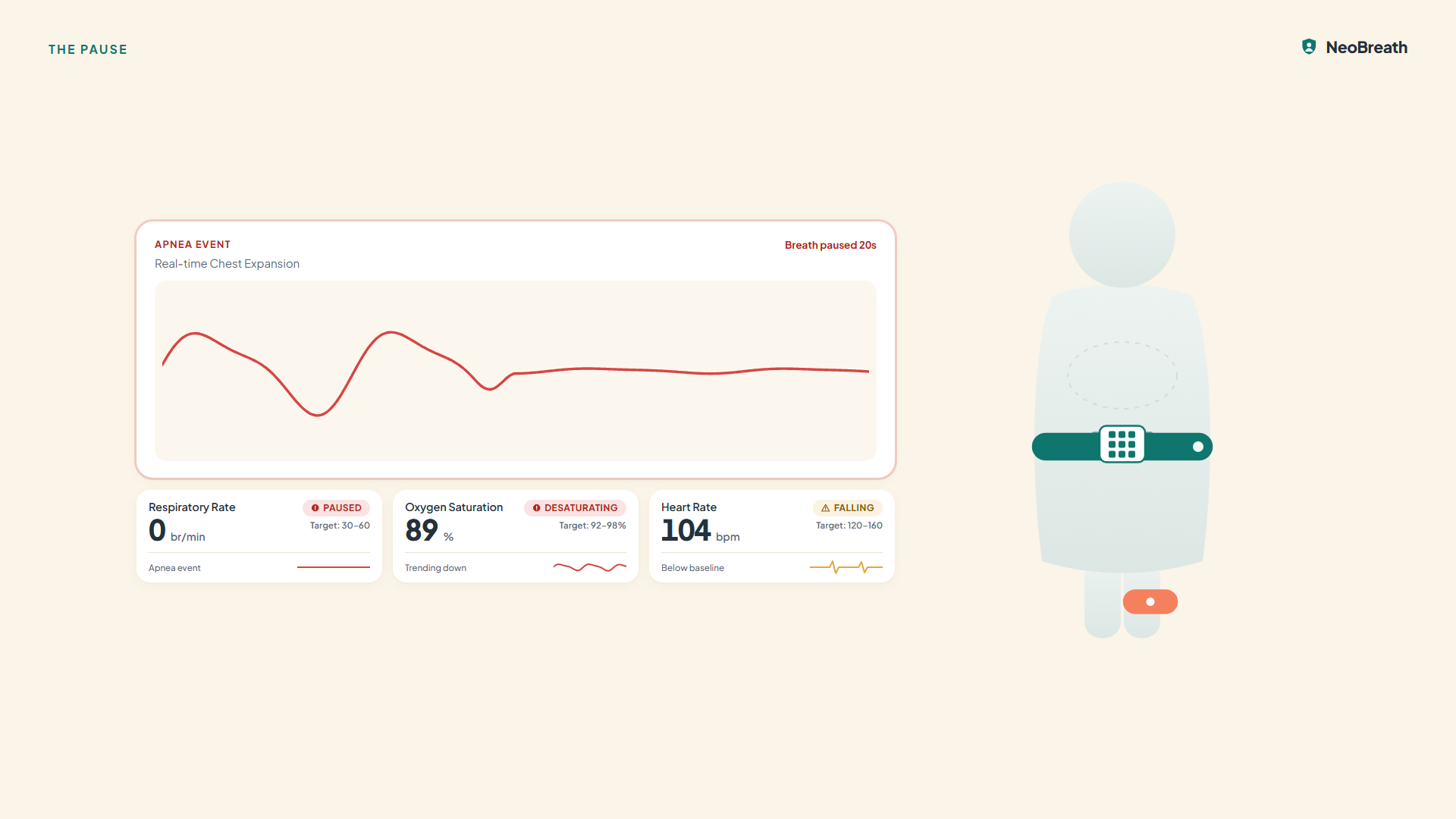
The wearable connects wirelessly to a mobile app, which shows the live trace, current vitals and event history.
TODAY— Built and demonstrated in the current prototype.
Current engineering focus
The prototype works; these are the parts that do not yet work well enough. They are listed as open problems rather than as progress bars, because a percentage would imply a measurement we have not made.
Belt sensitivity
The belt picks up abdominal movement, but sensitivity is not yet where it needs to be for reliable event detection.
The processing and power budget
Fitting sensing, wireless communication and eventual on-device inference inside the belt is an open constraint, not a solved one.
Signal interpretation
Distinguishing a true event from motion artifact is the active research problem, and the reason false alarms are the focus.
The caregiver’s view
The app shows a live trace, current vitals and event history. Its resting state is calm and monochrome on purpose: an interface that looks alarming when nothing is wrong trains people to ignore it.
Breathing normally
Continuous monitoring active · All vital signs within safe target range
Real-time Chest Expansion
Continuous Vitals
Respiratory Rate
44br/min
Oxygen Saturation (SpO₂)
96%
Heart Rate (Pulse)
148bpm
Baby Liam
22:14:56, Today
Slow Abdominal
Movement
Check if your child is okay. Gently stimulate Liam. Make sure the sensor is properly worn and securely attached.
Dismiss