Research
The AI direction, and how far along it is
What we are working on now, what is merely proposed, and the published work that informs the direction.
Why false alarms are the first problem
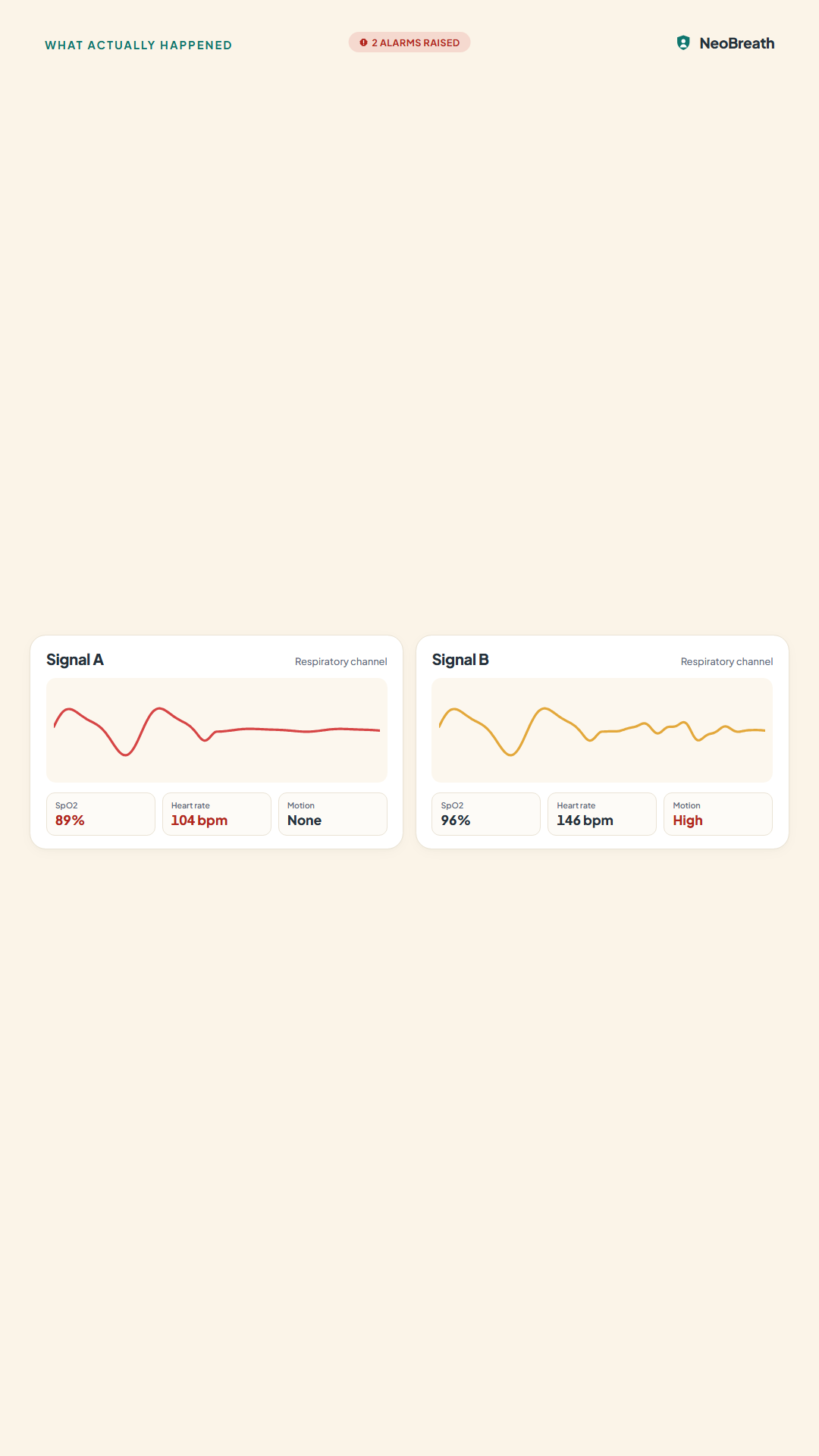
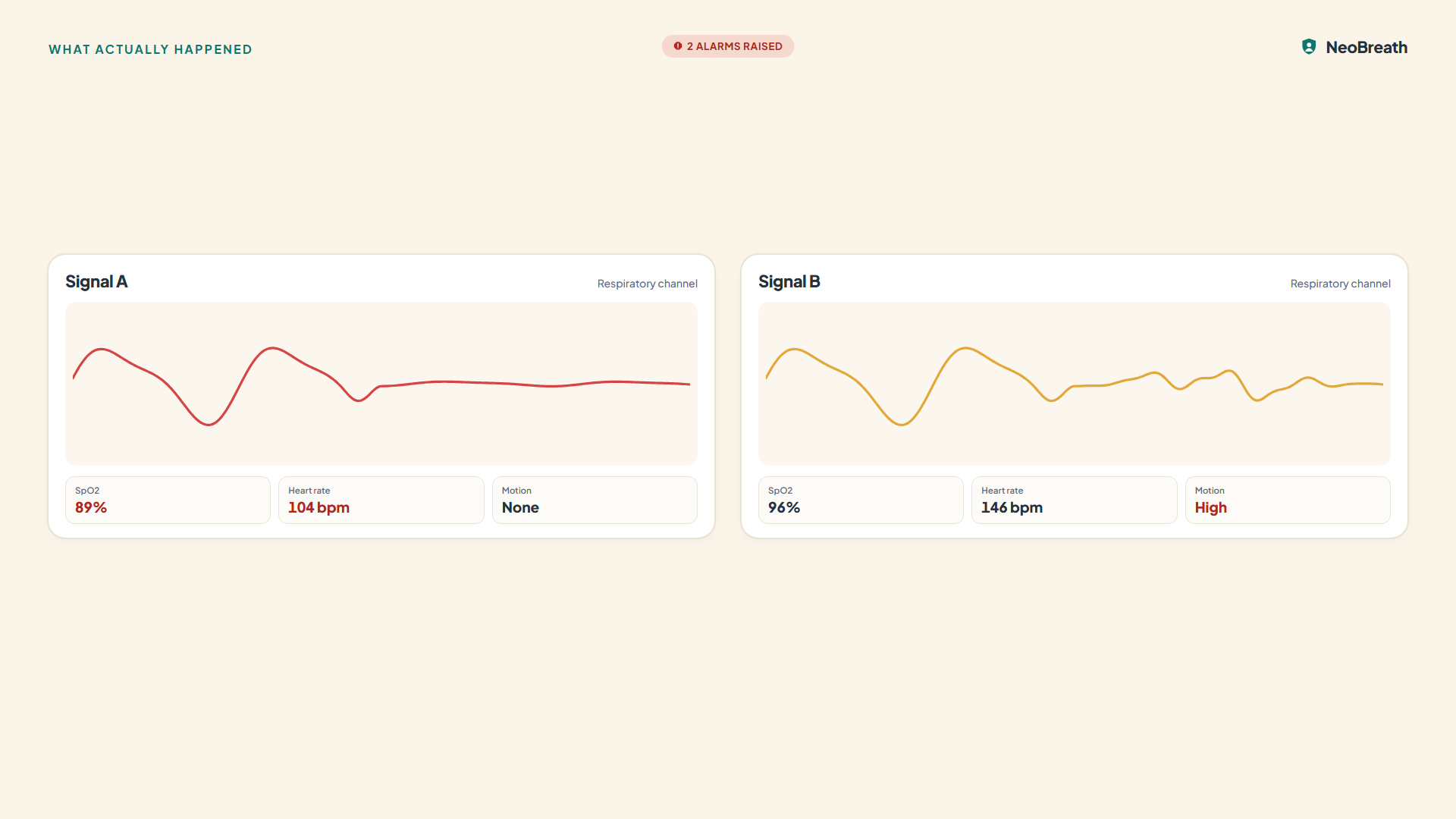
A wearable does not produce a clean physiological signal. An infant moving can generate a pattern that resembles deterioration, and a fixed threshold cannot tell the difference. Published work from the same research line reports a high proportion of false central-apnea alarms in clinical practice — the problem is not a shortage of alarms.
Literature
Published work we draw on
Varisco et al., on machine-learning-based central apnea detection in premature infants — evidence that the approach is worth pursuing.
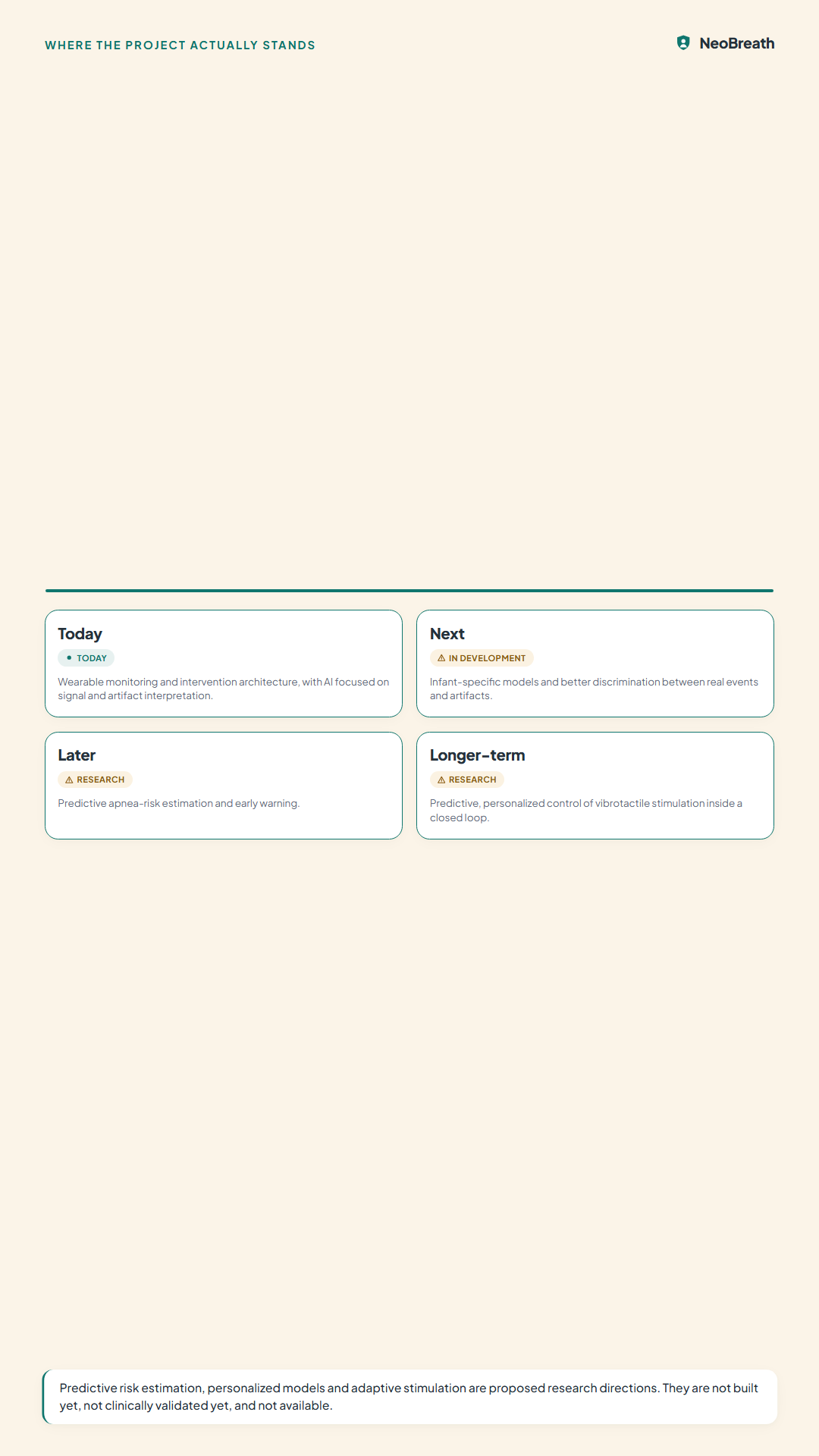
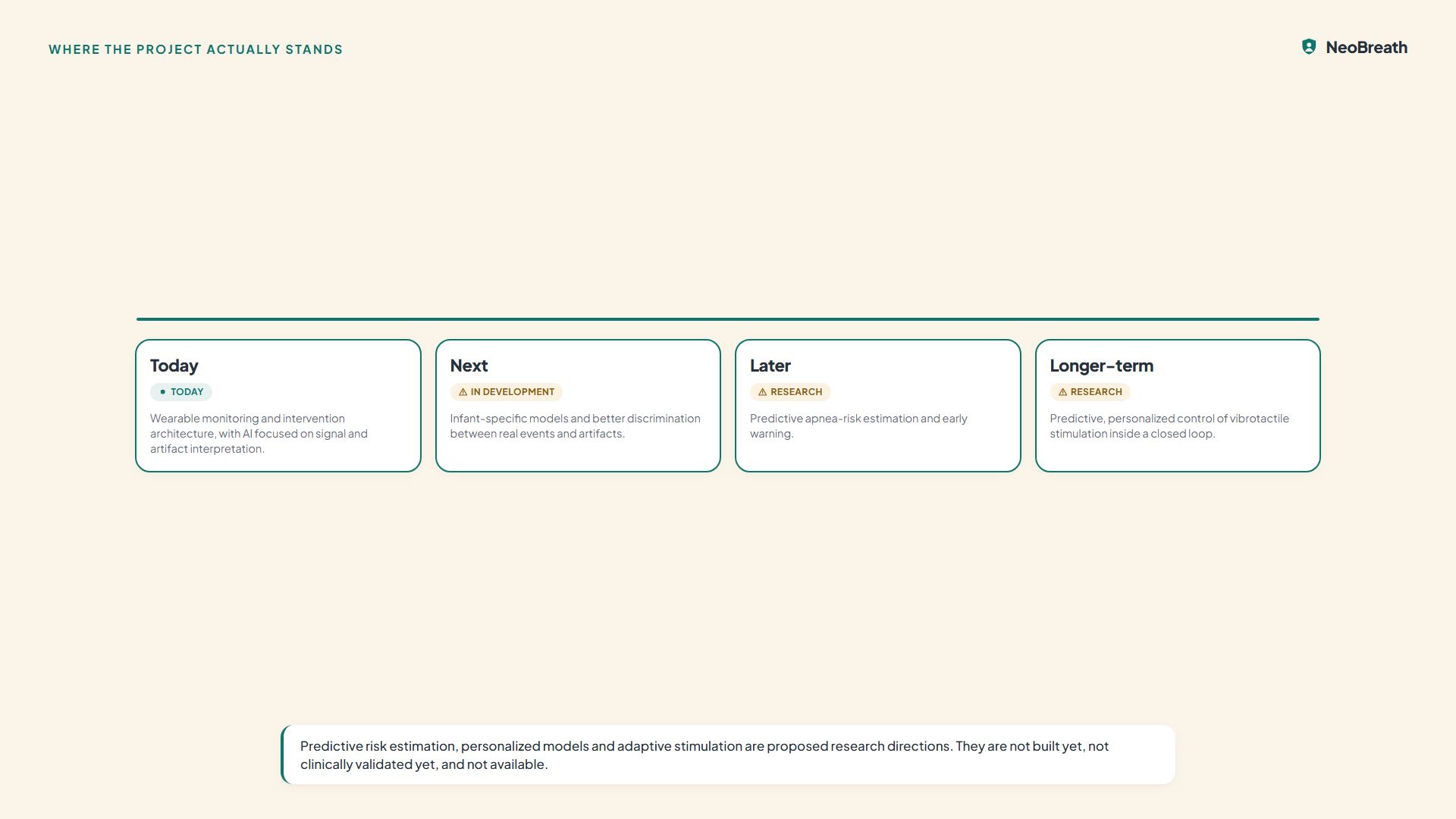
IN DEVELOPMENT— Active engineering or research work. Not finished. The literature supports the research direction. NeoBreath has not yet demonstrated equivalent clinical performance, and must never imply that it has.Work reporting a high proportion of false central-apnea alarms in clinical practice, which frames the false-alarm problem as the priority.
TODAY— Built and demonstrated in the current prototype. This describes the published literature, not a measurement of NeoBreath.Smith et al. (2015) and Zeldich et al. (2021), on mechanical stimulation and stochastic resonance in apnea of prematurity — informing the intervention work.
IN DEVELOPMENT— Active engineering or research work. Not finished. Informed by research into mechanical stimulation and stochastic resonance. The therapeutic benefit of mechanical stimulation does not establish that randomness is the active mechanism.
We cite this work because it supports the research direction. It is not evidence about NeoBreath, and we do not present it as such.
What this page does not claim
- That NeoBreath has demonstrated clinical performance comparable to any published study.
- That a specific model has been selected — the candidate families are an open question.
- That predictive risk estimation or adaptive stimulation exist. They are proposed.
- That randomness is the proven mechanism of the intervention. That remains an open scientific question.
Work on this with us
Artifact rejection on low-power wearable hardware is the open technical problem. If that is your area, we would like to talk.
Talk to the team